
 Fast Mental Math: 5 Vedic Multiplication Tricks to Multiply Multi-Digit Numbers in Under 5 Seconds

When onlookers watch a mental math champion multiply 98 × 97 or 104 × 108 in less than three seconds without touching a pencil, it appears to border on supernatural genius. Yet, behind this astonishing computational speed lies no secret sorcery — only the ancient mathematical elegance of Vedic Mathematics. Rediscovered between 1911 and 1918 by Swami Bharati Krishna Tirtha from ancient Indian Sanskrit texts, Vedic Math is composed of 16 core Sutras (word-formulas) that reduce cumbersome arithmetic procedures into lightning-fast mental patterns.
Whether you are a student preparing for competitive timed examinations (such as the SAT, Olympiad, CAT, Banking, or GRE), or a lifelong learner seeking to supercharge your arithmetic agility, these five core Vedic multiplication techniques will permanently change how you perceive numbers.
1. The Base Method (Nikhilam Sutra): Multiplying Numbers Near 100
The Nikhilam Navatashcaramam Dashatah sutra ("All from 9 and the last from 10") is the ultimate shortcut for multiplying numbers close to a common base of 100, 1000, or 10,000.
Scenario A: Both Numbers Just Below 100 (96 × 94)
Traditional multiplication requires four separate cross-multiplications and three column additions. Here is the Vedic method:
- Find the deviation (deficiency) of each number from 100:
- 96 is -4 away from 100.
- 94 is -6 away from 100.
- Left Part of the Answer: Cross-subtract either deviation:
96 - 6 = 90 (or 94 - 4 = 90)
- Right Part of the Answer: Multiply the two deviations together:
(-4) × (-6) = 24
- Combine the two parts: 9,024!
Check on your calculator: 96 × 94 = 9,024. Computed entirely in your head in under 3 seconds!
Scenario B: Both Numbers Just Above 100 (107 × 105)
- Deviations from 100: +7 and +5.
- Left part: Cross-add:
107 + 5 = 112(or105 + 7 = 112). - Right part: Multiply deviations:
7 × 5 = 35. - Final product: 11,235!
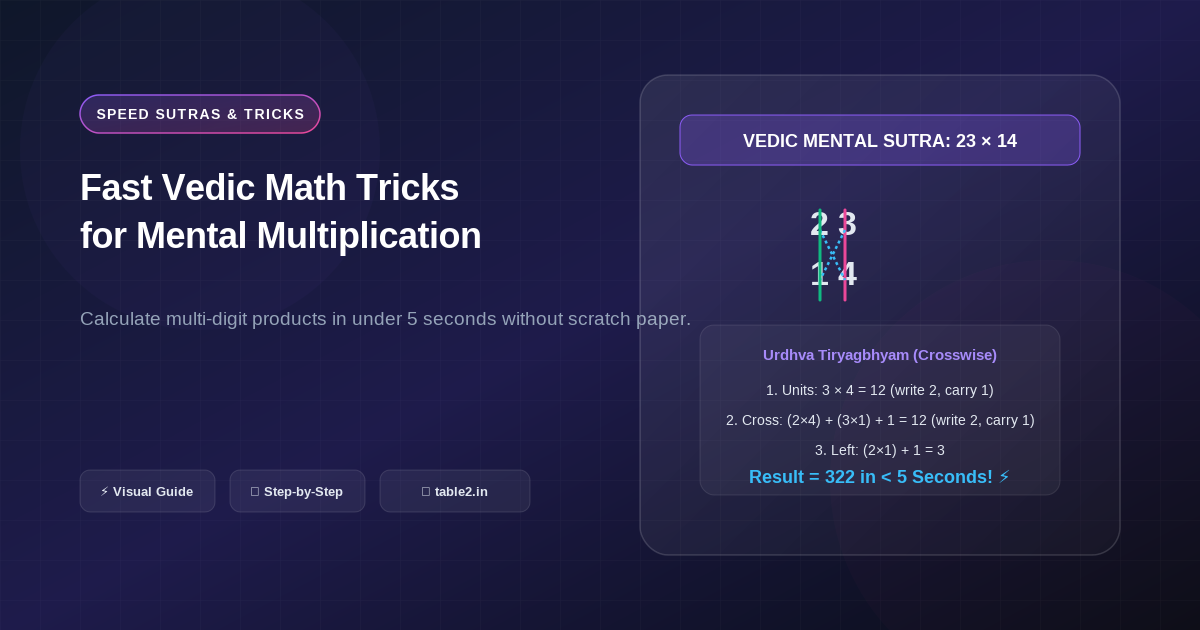
2. Vertical & Crosswise (Urdhva Tiryagbhyam): Any 2-Digit Numbers (43 × 21)
The Urdhva Tiryagbhyam sutra ("Vertically and Crosswise") is universal: it works on any two numbers, regardless of whether they are near a base. For 43 × 21, visualize three rapid steps:
| Step | Action | Calculation | Result Digit |
|---|---|---|---|
| Step 1 (Right Vertical) | Multiply ones digits: 3 × 1 | 3 × 1 = 3 | Ends in 3 |
| Step 2 (Crosswise Sum) | Cross-multiply and add: (4×1) + (3×2) | 4 + 6 = 10 | Put 0, carry 1 |
| Step 3 (Left Vertical) | Multiply tens digits: 4 × 2, add carry | 8 + 1 = 9 | Starts with 9 |
Combine the digits from left to right: 903! Practice multi-digit multiplication on our Multi-Digit Multiplication Worksheet.
3. Multiplying Any Number by 11 in Seconds (Antya-Sutra)
Multiplying by 11 requires zero actual multiplication — only simple addition! Simply insert the sum of the digits between the digits themselves:
- To solve
45 × 11: Put4 + 5 = 9between 4 and 5 → 495! - To solve
36 × 11: Put3 + 6 = 9between 3 and 6 → 396! - With Carry-Over: To solve
78 × 11:7 + 8 = 15. Write down the 5, and carry the 1 to the 7:(7 + 1) and 58 = 858!
For 3-digit numbers like 253 × 11, sandwich adjacent sums:
- First digit: 2
- Second digit:
2 + 5 = 7 - Third digit:
5 + 3 = 8 - Last digit: 3
- Result: 2,783!
4. The "Last Digits Sum to 10" Trick (Ekadhikena Purvena)
This lightning trick applies whenever two conditions are met:
- The tens digits are identical.
- The ones digits sum to exactly 10 (e.g., 63 × 67, 84 × 86, 72 × 78).
To multiply 63 × 67:
- Left part: Multiply the tens digit by the next integer (
6 × 7 = 42). - Right part: Multiply the ones digits directly (
3 × 7 = 21). - Combine: 4,221!
To square any number ending in 5 (like 75²): 7 × 8 = 56, append 25 → 5,625!
5. Multiplying Any Number by 99, 999, or 9999 (Ekanyunena Purvena)
To multiply any 2-digit number by 99 (e.g., 58 × 99):
- Subtract 1 from the number:
58 - 1 = 57(first two digits). - Subtract each digit of 57 from 9:
9 - 5 = 4and9 - 7 = 2→ 42. - Combine: 5,742!
Check: 58 × 99 = 5,742. This works for any magnitude: 342 × 999 = 341,658!
6. How to Build Vedic Math Speed Daily
Vedic math is a muscle; without practice, mental shortcuts fade. Sharpen your mental reflexes with daily 5-minute training:
- Test your arithmetic recall on our Arithmetic Speed Test.
- Practice 2-digit column drills with our 2-Digit by 1-Digit Worksheet.
- Track your score and compare times using our Speed Test Engine.
7. Comparing Traditional Long Multiplication vs Vedic Math: Time & Efficiency
To appreciate the efficiency of Vedic mathematics, let us compare solving a 3-digit multiplication problem: 994 × 992.
Traditional Method:
- Multiply 994 by 2 → 1,988 (requires 3 steps + carries).
- Multiply 994 by 90 → 89,460 (requires 3 steps + placeholder zero).
- Multiply 994 by 900 → 894,600 (requires 3 steps + two placeholder zeros).
- Add four large numbers together:
1,988 + 89,460 + 894,600 = 986,048. - Total time: 45 to 65 seconds with multiple opportunities for column addition slips.
Vedic Nikhilam Method:
- Base is 1000. Deviations: 994 is -006, and 992 is -008.
- Left part:
994 - 8 = 986. - Right part:
(-6) × (-8) = 048(since base 1000 has three zeros, right part needs 3 digits). - Combine: 986,048!
- Total time: 3 seconds entirely in your head!
Sutra 3: "Antyayordasake'pi" (When Sum of Last Digits Equals 10)
One of the most dazzling and practical Vedic Math techniques is the Antyayordasake'pi sub-sutra, which translates to: "When the sum of the last digits is 10, and the previous parts are identical." This sutra allows anyone to multiply specific two-digit numbers in under 2 seconds flat.
The Golden Conditions:
- The tens digits (or leading portions) must be identical.
- The units digits must add up to exactly 10 (e.g., $3 + 7 = 10$, $4 + 6 = 10$, $1 + 9 = 10$, $5 + 5 = 10$).
Step-by-Step Worked Example: Solve $73 \times 77$
- Left Part of Product: Take the common leading digit ($7$) and multiply it by its immediate consecutive successor ($7 + 1 = 8$):
$$\text{Left Side} = 7 \times 8 = \mathbf{56}$$ - Right Part of Product: Multiply the units digits directly ($3 \times 7$):
$$\text{Right Side} = 3 \times 7 = \mathbf{21}$$ - Combine Sides: Concatenate the two results: $\mathbf{5,621}$. Check with a calculator: $73 \times 77 = 5621$!
Another Example: Squaring Numbers Ending in 5 ($85 \times 85$)
Because $5 + 5 = 10$ and both tens digits are $8$:
Left side: $8 \times (8 + 1) = 8 \times 9 = 72$
Right side: $5 \times 5 = 25$
Result: $\mathbf{7,225}$. You can now mentally square 15, 25, 35, 45, 65, 75, 85, 95 in the blink of an eye!
| Problem | Condition Check | Left Part Calculation | Right Part Calculation | Instant Mental Answer |
|---|---|---|---|---|
| 42 × 48 | Tens=4, 2+8=10 | 4 × 5 = 20 | 2 × 8 = 16 | 2,016 |
| 64 × 66 | Tens=6, 4+6=10 | 6 × 7 = 42 | 4 × 6 = 24 | 4,224 |
| 91 × 99 | Tens=9, 1+9=10 | 9 × 10 = 90 | 1 × 9 = 09 (keep 2 digits) | 9,009 |
| 105 × 105 | Leading=10, 5+5=10 | 10 × 11 = 110 | 5 × 5 = 25 | 11,025 |
Vedic Math in Competitive Exams (SAT, GRE, Banking & Olympiads)
In high-stakes standardized entrance exams such as the SAT, GRE, GMAT, and civil service aptitude tests, the difference between a 90th percentile and 99th percentile score frequently comes down to time efficiency. Test writers intentionally embed lengthy calculation hurdles designed to trap students using sluggish column arithmetic.
By mastering Vedic shortcuts, candidates bypass scratch paper entirely, freeing up critical cognitive reserves for logical reasoning and data interpretation. Compare this mental flexibility with traditional tables using our comprehensive Multiplication Chart 1 to 100 to strengthen your basic factor pairs before applying speed sutras.
Sutra 4: "Yavadunam" (Squaring Numbers Near Powers of 10)
The Yavadunam sutra, meaning "By whatever the extent of its deficiency or excess," is the crown jewel of mental squaring. It allows anyone to square two-digit and three-digit numbers close to 100 in mere seconds without paper.
Rule for Squaring Numbers Just Above 100 (e.g., $106^2$):
- Identify the Excess ($x$): How much greater is 106 than 100? The excess is $+6$.
- Calculate Left Side (Number + Excess): Add the excess to the original number:
$$\text{Left Side} = 106 + 6 = \mathbf{112}$$ - Calculate Right Side (Excess Squared): Square the excess ($6^2$):
$$\text{Right Side} = 6^2 = \mathbf{36}$$ - Combine Both Halves: Concatenate the two parts: $\mathbf{11,236}$. Verification: $106 \times 106 = 11,236$!
Rule for Squaring Numbers Just Below 100 (e.g., $94^2$):
- Identify the Deficiency ($d$): How much less is 94 than 100? The deficiency is $-6$.
- Calculate Left Side (Number - Deficiency): Subtract the deficiency from the number:
$$\text{Left Side} = 94 - 6 = \mathbf{88}$$ - Calculate Right Side (Deficiency Squared): Square the deficiency ($6^2$):
$$\text{Right Side} = 6^2 = \mathbf{36}$$ - Combine Both Halves: Concatenate: $\mathbf{8,836}$. Verification: $94 \times 94 = 8,836$!
| Number to Square | Deviation from 100 | Left Side (Number ± Deviation) | Right Side (Deviation²) | Final Mental Square |
|---|---|---|---|---|
| 103² | +3 | 103 + 3 = 106 | 3² = 09 (two digits) | 10,609 |
| 108² | +8 | 108 + 8 = 116 | 8² = 64 | 11,664 |
| 97² | -3 | 97 - 3 = 94 | (-3)² = 09 | 9,409 |
| 91² | -9 | 91 - 9 = 82 | (-9)² = 81 | 8,281 |
Why Indian Vedic Math Is Taking Global Classrooms by Storm
Modern cognitive scientists have discovered that Vedic mathematical sutras align precisely with how human working memory operates. Conventional vertical algorithms require maintaining multiple carried numbers in temporary buffer memory while simultaneously multiplying and aligning decimal places. In contrast, Vedic techniques organize calculations into one-line symmetrical patterns that match natural visual scanning.
Whether you are preparing for competitive Olympiads, college entrance tests, or simply looking to sharpen your arithmetic reflexes, Vedic Math transforms calculations into pure joy. Ground your mental arithmetic in rock-solid foundational fluency with our free Multiplication Chart 1 to 12 reference tool!
Comprehensive Comparison: Traditional Long Multiplication vs. Vedic Methods
To truly appreciate the computational efficiency of Vedic mathematics, let's contrast how a 5th grader solves $98 \times 97$ using the standard American/European column algorithm versus the Vedic Nikhilam Sutra:
| Metric / Dimension | Traditional Column Method | Vedic Math (Nikhilam Sutra) |
|---|---|---|
| Total Steps Required | Multiply $7 \times 98$ (carry 5, get 686), add placeholder 0, multiply $9 \times 98$ (carry 7, get 8820), then add columns: $686 + 8820 = 9506$. (4 distinct arithmetic operations + 2 carries). | Identify deficits from 100: $-2$ and $-3$. Cross-subtract: $98 - 3 = 95$. Multiply deficits: $(-2) \times (-3) = 06$. Combine: $\mathbf{9,506}$. (Done entirely in head in 1 step). |
| Working Memory Load | High: must store carries, align columns accurately on paper, and execute long multi-column addition. | Minimal: operates on small single-digit differences ($2 \times 3 = 6$) rather than high-digit products. |
| Average Execution Time | 30 to 45 seconds on paper with pencil. | 2 to 4 seconds purely mental without writing. |
| Error Probability | Moderate to high (misaligned columns, forgotten carries, addition mistakes). | Extremely low due to simplicity of single-digit calculations. |
Classroom Implementation: How Teachers Introduce Vedic Math Modules
In modern progressive classrooms, educators do not replace the standard curriculum with Vedic Math overnight. Instead, they introduce Vedic sutras as weekly "Math Magic Friday" modules. Presenting techniques like Ekadhikena Purvena or Nikhilam as mathematical shortcuts sparks immense student curiosity and motivates even reluctant learners to participate actively.
When students realize that ancient mathematicians developed elegant mental algorithms thousands of years ago to bypass tedious mechanical paperwork, it deepens their respect for the universal beauty and cultural richness of mathematical history.
Recommended Practice Regimen
Dedicate just 5 minutes every morning to solving 3 mental problems using one of the five Vedic sutras. In less than two weeks, your speed and mental accuracy will outperform standard calculator typing time, unlocking an enduring sense of mathematical mastery.
With consistent daily practice, Vedic mathematics unlocks extraordinary numerical confidence, turning complex arithmetic from an intimidating chore into a lifelong intellectual superpower for students and adults alike.