
मुंहजबानी गुणा (Mental Math Multiplication) के 10 तेज ट्रिक्स: बिना कैलकुलेटर दिमाग में हल करें
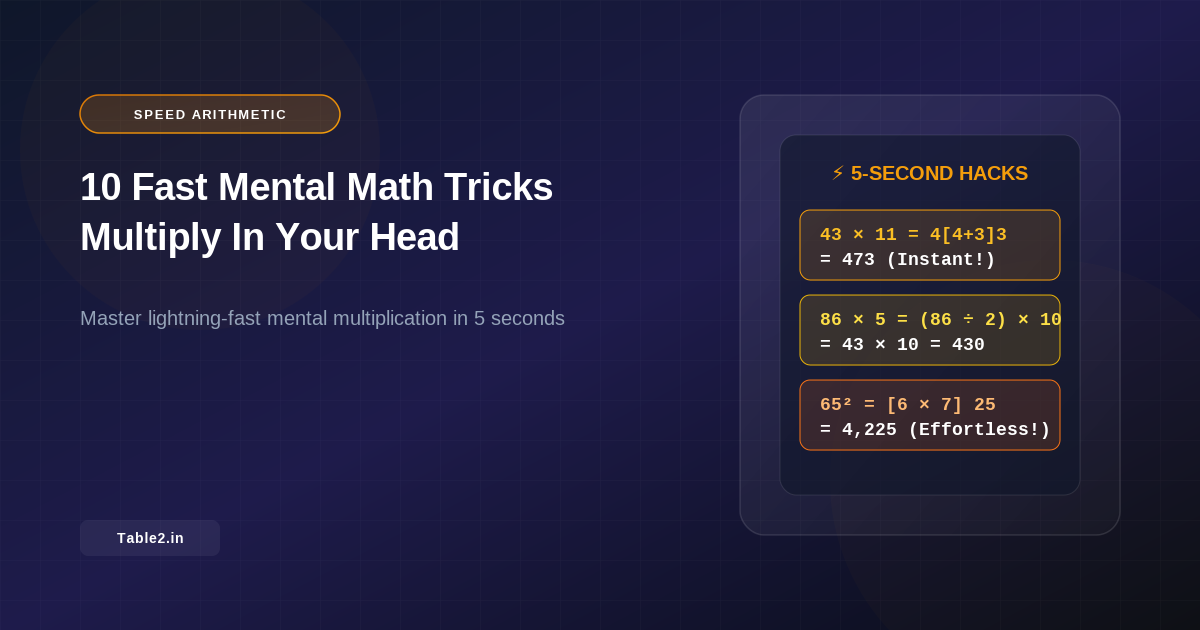
In an era dominated by smartphones, touchscreens, and digital smartwatches, the ability to calculate rapidly in your head might seem like a nostalgic lost art. Yet, developing sharp mental math capabilities remains one of the single greatest cognitive superpowers you can possess. Whether you are splitting a dinner bill among friends, calculating sales discounts during a shopping trip, estimating home improvement budgets, or acing competitive exams, mental calculation confers instant confidence, sharp focus, and numerical fluency.
Contrary to popular belief, mental math prodigies are not human computers born with photographic memories. Instead, they rely on a repertoire of elegant mathematical shortcuts, algebraic identities, and modular tricks that dismantle intimidating calculations into bite-sized mental steps. In this masterclass guide, we reveal 10 lightning-fast mental math multiplication tricks that will allow you to multiply 2-digit and 3-digit numbers in your head within seconds. To test your raw recall speed, try our Times Table Speed Test, explore our foundational Times Tables 2 to 20, or practice with our Multiplication Flashcards.
Trick 1: The Magic of Multiplying Any 2-Digit Number by 11
Multiplying by 11 is universally regarded as the most spectacular party trick in elementary arithmetic. You never have to set up vertical multiplication.
The Rule: To multiply any 2-digit number by 11, simply split the two digits apart and place their sum in the middle!
- Example A (No Carry):
35 × 11- Split 3 and 5 apart:
3 [ ] 5. - Add the two digits together:
3 + 5 = 8. - Insert the sum in the middle: 385. (Check:
35 × 11 = 385).
- Split 3 and 5 apart:
- Example B (With Carry-Over):
78 × 11- Split 7 and 8 apart:
7 [ ] 8. - Add the two digits:
7 + 8 = 15. - Place the 5 in the middle and carry the 1 over to the hundreds place:
(7 + 1) [5] 8 = 858. (Check:78 × 11 = 858).
- Split 7 and 8 apart:
Trick 2: Squaring Any Number Ending in 5 in Under 2 Seconds
Squaring numbers like 25, 65, 85, or 115 looks daunting on paper, but it can be completed instantly using the algebraic identity (10n + 5)² = 100n(n + 1) + 25.
The Rule: Every square of a number ending in 5 ends in 25. To find the first digits, take the tens digit and multiply it by the very next consecutive integer (n × (n + 1))!
- Example A: What is
35²?- Take the tens digit (3) and multiply it by the next number (4):
3 × 4 = 12. - Append 25 to the end: 1,225.
- Take the tens digit (3) and multiply it by the next number (4):
- Example B: What is
75²?- Take 7 and multiply by 8:
7 × 8 = 56. - Append 25: 5,625.
- Take 7 and multiply by 8:
- Example C: What is
105²?- Take 10 and multiply by 11:
10 × 11 = 110. - Append 25: 11,025.
- Take 10 and multiply by 11:
Trick 3: The Base-100 Technique (Multiplying Numbers in the 90s)
When multiplying two numbers close to 100 (such as 96 × 97), normal long multiplication involves tedious carries. The Vedic Base Method turns this into simple subtraction.
The Rule: Look at how far each number is below 100 (their deficits):
- For
96 × 97: 96 is 4 below 100, and 97 is 3 below 100. - Step 1 (First Digits): Cross-subtract either deficit:
96 - 3 = 93(or97 - 4 = 93). These are your first two digits! - Step 2 (Last Digits): Multiply the two deficits together:
4 × 3 = 12. - Combine the parts: 9,312!
92 × 98. Deficits are 8 and 2. 92 - 2 = 90, and 8 × 2 = 16. Answer: 9,016. This mental trick works in 3 seconds flat!
Trick 4: The Doubling and Halving Strategy
Whenever you are multiplying two numbers where one number is even and the other ends in 5 (or is awkward to calculate), you can double one number and halve the other without altering the product!
Algebraically: A × B = (A ÷ 2) × (B × 2).
- Problem:
16 × 35- Halve 16:
16 ÷ 2 = 8. - Double 35:
35 × 2 = 70. - The problem becomes:
8 × 70 = 560!
- Halve 16:
- Problem:
14 × 45- Halve 14 to 7, double 45 to 90.
- Compute:
7 × 90 = 630. Effortless!
Trick 5: Multiplying by 5, 25, and 50 Using Powers of 10
Never multiply by 5, 25, or 50 directly. Since our numbering system is base-10, it is vastly faster to multiply by 10, 100, or 1000 and then divide by 2 or 4:
| Multiplier | Mental Shortcut Formula | Worked Example: 68 × Multiplier |
|---|---|---|
| Multiply by 5 | Multiply by 10, then halve: (N × 10) ÷ 2 |
68 × 10 = 680, then 680 ÷ 2 = 340 |
| Multiply by 50 | Multiply by 100, then halve: (N × 100) ÷ 2 |
68 × 100 = 6,800, then 6,800 ÷ 2 = 3,400 |
| Multiply by 25 | Multiply by 100, then divide by 4: (N × 100) ÷ 4 |
68 ÷ 4 = 17, then 17 × 100 = 1,700 |
Trick 6: Multiplying by 9, 99, or 999 (The Compensation Method)
Whenever you need to multiply by a number that is one less than a round power of 10, use the distributive compensation property N × 99 = N × (100 - 1) = 100N - N.
- Example:
47 × 99- Multiply by 100:
47 × 100 = 4,700. - Subtract the original number:
4,700 - 47 = 4,653.
- Multiply by 100:
- Example:
83 × 9- Multiply by 10:
83 × 10 = 830. - Subtract 83:
830 - 83 = 747.
- Multiply by 10:
Trick 7: The Difference of Two Squares Shortcut
When multiplying two numbers that are equidistant from a round number (such as 48 × 52 or 29 × 31), use the classic algebraic formula: (x - y)(x + y) = x² - y².
- Example A:
48 × 52- The midpoint between 48 and 52 is 50, with a difference of 2.
- Compute:
50² - 2² = 2,500 - 4 = 2,496.
- Example B:
37 × 43- Midpoint is 40, distance is 3.
- Compute:
40² - 3² = 1,600 - 9 = 1,591.
Trick 8: Splitting and Distributing from Left to Right
In traditional pen-and-paper math, you multiply right to left (ones first, carrying over to tens). In mental math, you should always calculate left to right, starting with the largest place value. This allows you to hold intermediate sums naturally in your working memory.
For example, to compute 7 × 68 in your head:
- Decompose 68 into
60 + 8. - Multiply the tens:
7 × 60 = 420. - Multiply the ones:
7 × 8 = 56. - Add together:
420 + 56 = 476.
Trick 9: The 9-Times Table Finger Trick for Elementary Learners
For young children learning their 9s, the physical finger hack provides instant reassurance:
- Hold both hands flat in front of you with palms facing your chest (10 fingers total, numbered 1 to 10 from left thumb to right thumb).
- To multiply
9 × 4, fold down your 4th finger (the left index finger). - Count the fingers to the left of the folded finger: 3 fingers (tens digit).
- Count the fingers to the right: 6 fingers (ones digit).
- Combine them: 36! This visual hack works flawlessly for
9 × 1through9 × 10.
Trick 10: Vedic Criss-Cross Multiplication for Any 2-Digit Numbers
For arbitrary 2-digit numbers (like 32 × 41) where no special shortcuts apply, use the Vedic "Vertically and Crosswise" (Urdhva Tiryagbhyam) pattern:
- Multiply Right Column (Units):
2 × 1 = 2(Right digit is 2). - Cross-Multiply and Add:
(3 × 1) + (2 × 4) = 3 + 8 = 11. (Middle digit is 1, carry 1). - Multiply Left Column (Tens):
3 × 4 = 12, add carry 1:12 + 1 = 13. - Combine the pieces: 1,312! With a little practice, this 3-step visualization eliminates the need for paper entirely.
Put Your Mental Math to the Test
Mental math is like physical fitness: consistency builds permanent neural pathways. Spend 5 minutes daily challenging your arithmetic reflexes with our Times Table Speed Test, explore the Missing Factor Calculator, and test your problem-solving endurance with math games like Nerdle.
Trick 11: Successive Base Shifts (Multiplying by 12, 13, and 15)
Multiplying by teens (12 through 19) is a standard stumbling block for students who only memorize tables up to 10. You can dismantle any teen multiplication in your head using the Base Shift method:
- Multiplying by 12: Multiply the number by 10, then double the original number, and add them together:
N × 12 = (N × 10) + (N × 2). For instance,45 × 12 = 450 + 90 = 540. - Multiplying by 15: Multiply by 10, then add half of that product:
N × 15 = (N × 10) + [(N × 10) ÷ 2]. For instance,36 × 15 = 360 + 180 = 540.
Daily 5-Minute Mental Math Training Regimen
Cognitive neuroscientists have shown that regular mental arithmetic strengthens working memory capacity and spatial visualization in the parietal cortex. To make these 10 shortcuts second nature:
- Morning Number Walk: Pick three license plate numbers on your daily commute and test if they are divisible by 3, 4, 6, or 9.
- Retail Rounding Drill: Whenever you buy groceries or coffee, mentally calculate 15% and 20% tips before the card terminal prompts you.
- Gamified Speed Tests: Spend two minutes on our Times Table Speed Test to measure your response latency down to milliseconds.